The Medical Humanities minor integrates Georgetown’s strengths in health education and research with rich scholarship and teaching in the humanities and social sciences.
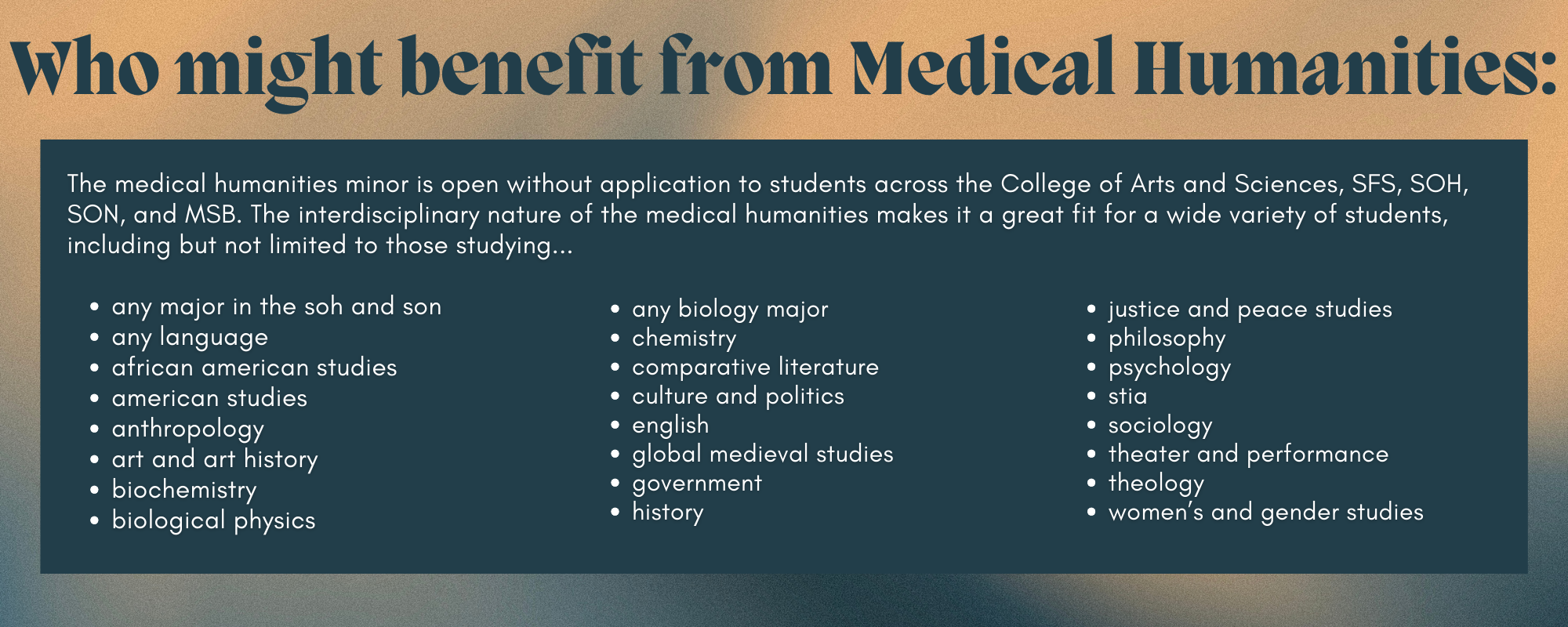
The minor is open without application to students across the College of Arts and Sciences, SFS, SOH, SON, and MSB, and is available (with instructor permission) to graduate and medical student auditors.
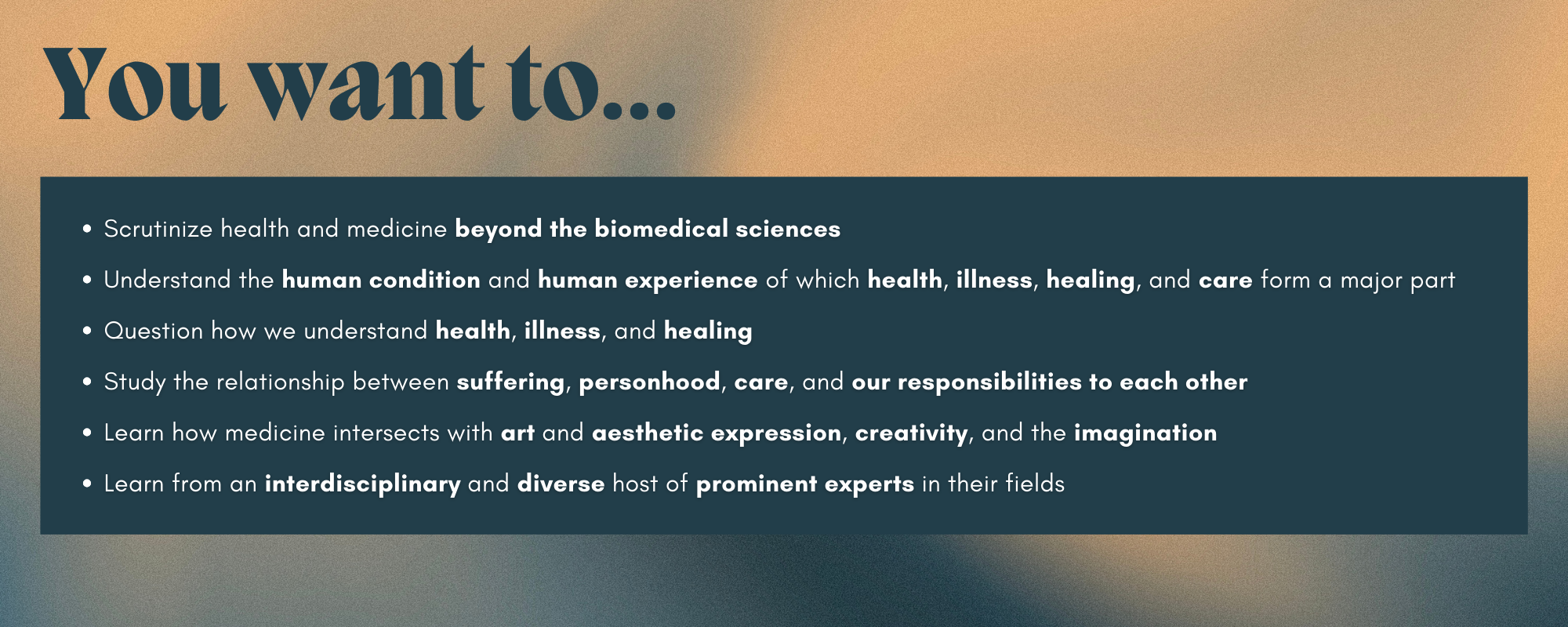
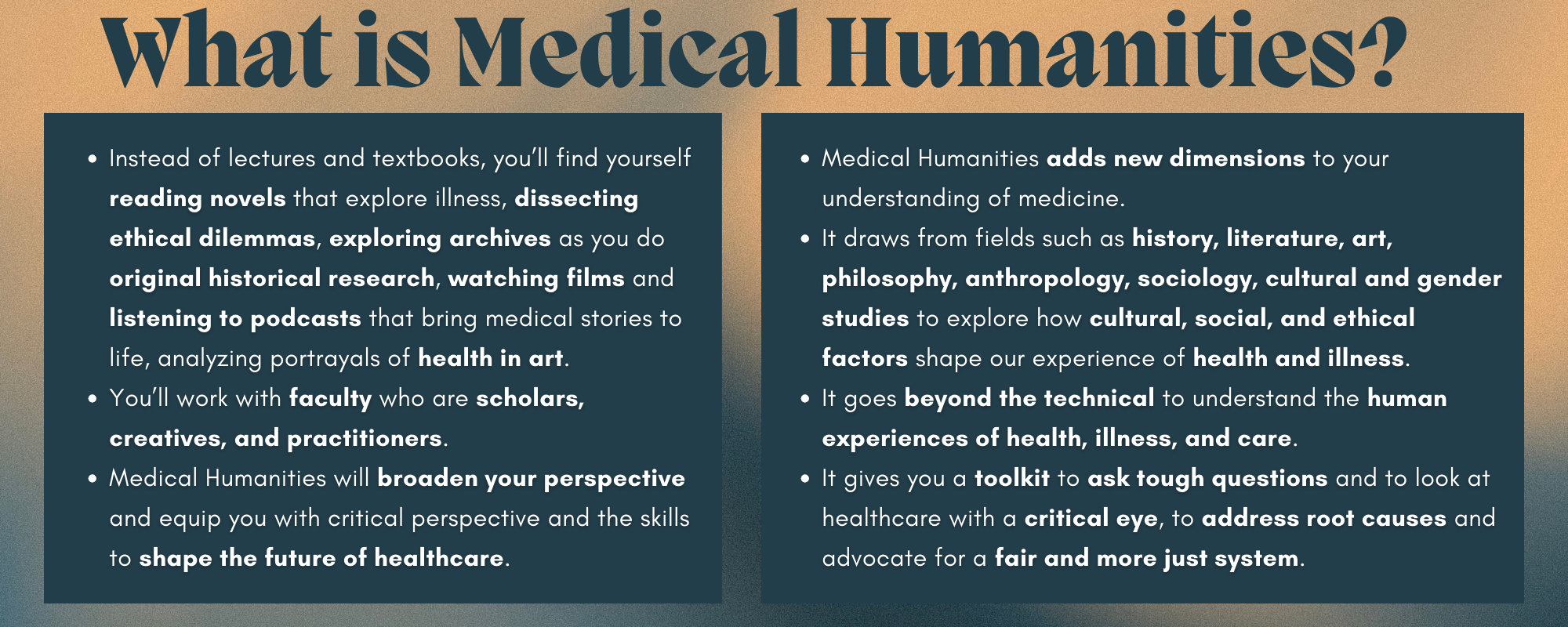
The interdisciplinary minor gives students the opportunity to examine the social, cultural, ethical, and historical facets of health and disease across areas such as history of medicine and public health, literature and medicine, bioethics, medical anthropology and sociology, science and technology studies, environmental health humanities, and visual and performing arts. In an era of global health challenges—from pandemics to health disparities—students develop critical frameworks to analyze how medicine and healthcare intersect with cultural contexts, historical grounding, and human experience. This interdisciplinary approach prepares future healthcare providers, researchers, and policymakers to address complex health challenges with both analytical rigor and human understanding.
Requirements for the Minor
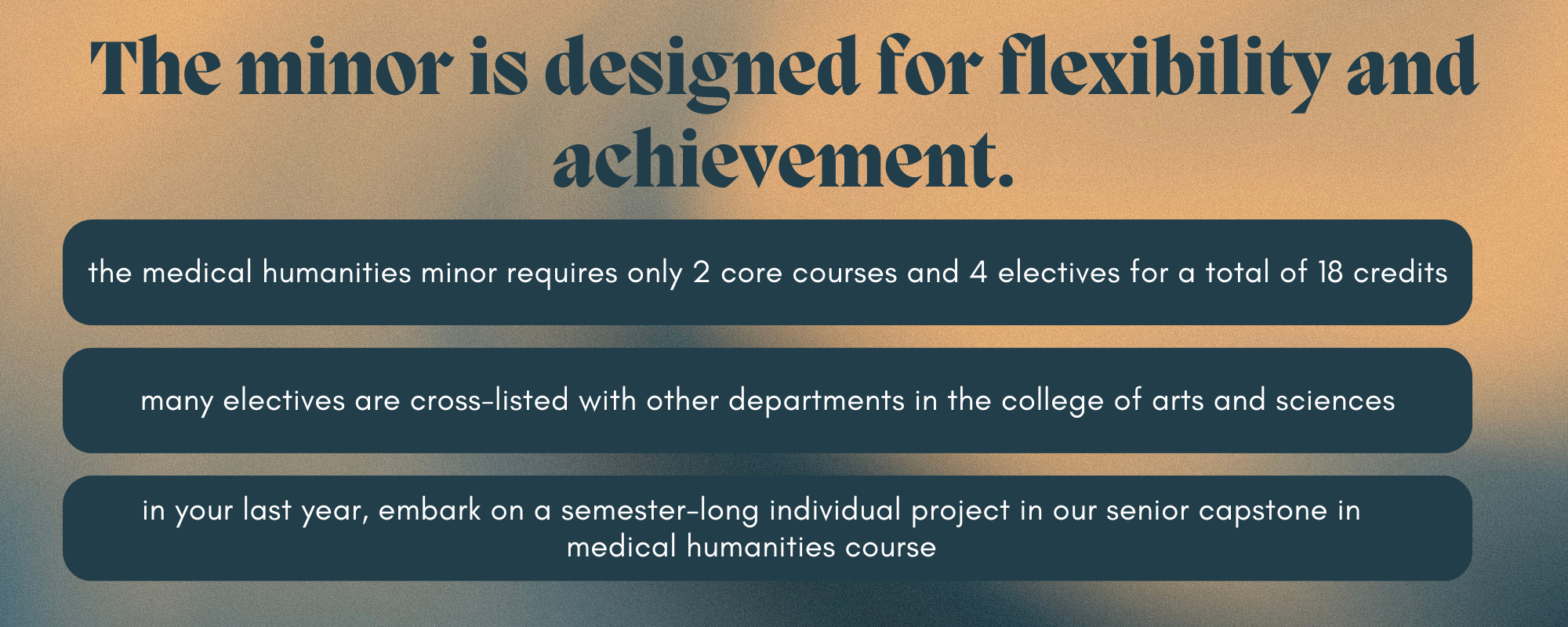
The minor requires 18 total credits / six total courses (two core courses and four electives) and is designed to provide students with a firm foundation in the field while developing their capacity to conduct original research. Up to 3 credits can be fulfilled by 1-credit courses.
Course Offerings
Core Courses
- MHUM-1101: Introduction to Medical Humanities
- MHUM-4960: Senior Capstone Seminar in Medical Humanities
Elective Courses
Students must complete four electives, selecting from Medical Humanities courses or approved cross-listed courses from other departments. The list of approved courses is updated each semester.
This list is not meant to be exhaustive. If students identify other courses that provide significant opportunities to engage with the medical humanities, they should present them to the Director for approval.
- ANTH 1111: Art and the Body
- ANTH 2250: Intro to Medical Anthropology
- ANTH 2252: Gender and Global Health
- ANTH 2256: Disability & Culture
- ANTH 2259: Plagues, Pandemics, and People
- ANTH 2301: Embodied Lives: Q St Ancestors
- ANTH 3510: Picturing Death
- ANTH 4258: Cultures of Childbirth
- BIOL 2104/BIOL-2504/HIST-4104: Global History of the Plague
- BIOL 2501: Global Health History
- BIOL 2600: Select Agents: Biology and Security
- BIOL 2670: Global Health History
- CULP 2260: Performance & Narratives of Pandemic Culture & Politics
- CLSS 2088: Magic and Science in the Mediterranean World
- ENGL 4180: Death in the Digital
- ENGL 4257: Disability Narratives
- FREN 4773: Maladies/Miracle Cures in 19th Century France
- GLOH 3356: Globalization & Health
- GLOH 4402: Convos in Health Global-Local
- GLOH 4416: Health Law and Governance: Global to Local
- GLOH 4420: Mental Health in Global Development
- GLOH 4440: Urbanization, Health & Environment
- HEST 1112: Nutrition/Disease Prevention
- HEST 2254: Intro to Healthcare Ethics
- HEST 3355: Health Equity Think Tank
- HEST 4400: Int Concepts in Mind-Body Med
- HEST 4430: Interdisciplinary Palliative Care
- IDST 135: Pandemics: Texts & Contexts
- IDST 2109: Health Inequities in the Time of COVID
- IDST 2120: Disability Justice at GU
- IDST 2121: Ethics: Research with Human Subjects
- IDST 135: Pandemics: Texts & Contexts
- LING 5313: Language and Health
- MHUM 1004: Death in America
- MHUM 1005: Medicine, Law, Ethics & End of Life
- MHUM 1007: The Problem of Suffering / IDST-2122: The Problem of Suffering
- MHUM 1008: Ethics of Research with Human Subjects
- MHUM 1103: Literature and Medicine
- MHUM 1110: War, Death, and Remembrance
- MHUM 1101: Introduction to Medical Humanities
- MHUM 1012/MHUM 4012: Art & the Power of Observation
- MHUM 1111: Public Health Ethics / PHIL-2004: Public Health Ethics
- MHUM 1112: Clinical Ethics / PHIL-2005: Clinical Ethics
- MHUM 1130: End of Life Ethics
- MHUM 1200: Insider/Outsider: The Anatomy of Identity
- MHUM 2100: Birth Narratives
- MHUM-2202: Methods in Medical Humanities
- MHUM 2210: How to End a Pandemic
- MHUM 2220: Pediatric Ethics
- MHUM 2250: War, Medicine, & Care in the 20th and 21st Centuries
- MHUM 2275: Medicine and the Muse
- MHUM 2300: Sculpture and Health
- MHUM 3330: Laughter is the Best Medicine
- MHUM 2400: Medicine and the Mythology of Race
- MHUM 3200: History of Animals in Medicine
- MHUM 3302: Death in America
- MHUM 3310: Literature of AIDS & Epidemics
- MHUM 3320: Medicalization of the Mind: Literature of Psychological Thought Pre-Freud
- MHUM 4450: Aging and Ageism
- MHUM 4949: Medical Humanities Tutorial
- MHUM 4960: Senior Capstone Seminar
- PHIL 2001: Bioethics
- PHIL 2002: Bioethics and Disability
- PHIL 2005: Clinical Ethics
- PHIL 2007:Philosophy of Medicine
- PHIL 2090: Ethics of AI & Health
- PHIL 4300: Neuroscience of Flavour
- PHIL 4302: Topics in Philosophy of Disability
- PHIL 4303: Bioethics and Mental Illness
- PHIL 4311: Philosophy of Health
- PHIL 4699: Violence: Psychology and Health
- PHIL 8301: Theories of Medical Ethics
- PSYC 2228: Social Psychology / PSYC-2400: Social Psychology
- PSYC 3220: Health Psychology
- PSYC 3810: Building Equitable Societies
- SOCI 3709: Sociology of Health/Illness
- SITA 3221: Global Health History and Politics
- SITA 3262: Culture, Reproductive Sci & Tech
- STIA 3257: Global Health Foundations
- SITA 3294: Global Health Security and Diplomacy
- SITA 4243/ASST 4047: Medicine and Power in India
- SITA 4555: Global Medicine and Technology
- STIA 4969: Mind, Madness, Meditation
- THEO 3030: Religion, Medicine and Disability
- WGST 2239: Medicine, Race & Gender
- UNXD 2109: Health Inequities in Context
- UNXD 3318-90: Health Innovation for the Common Good Equity?